William Rowan Hamilton
1805-1865
The Irish prodigy who reinvented the math of motion and, on a canal walk, carved into a bridge the four-number system (quaternions) that today keeps drones, spacecraft, and robot arms from tumbling out of control.
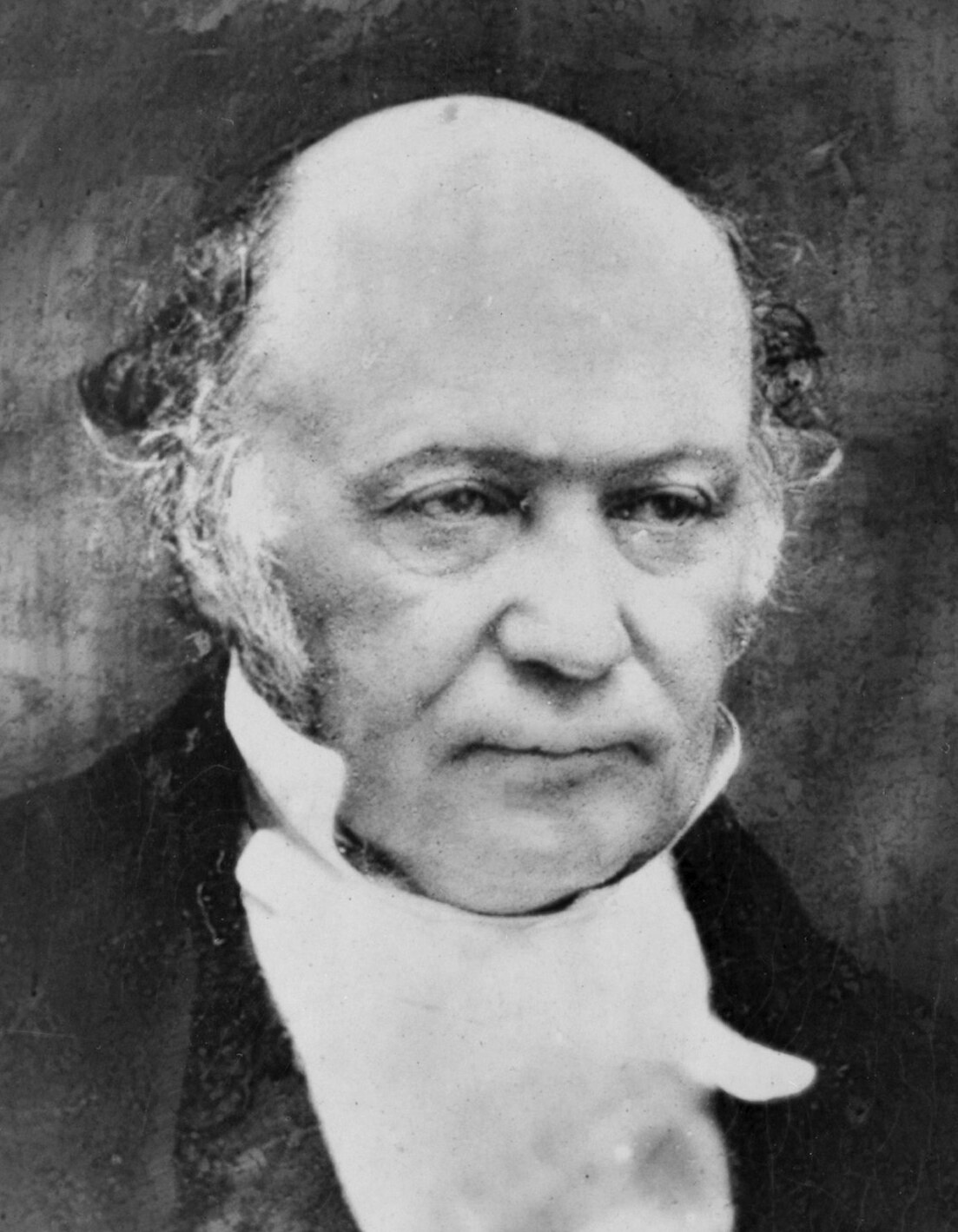
William Rowan Hamilton was born in Dublin in 1805, the fourth of nine children, and was a startling child. By age 13 he had picked up roughly a dozen languages, and he could run long calculations in his head. A bruising public arithmetic contest against the American prodigy Zerah Colburn (which Hamilton lost) pushed him away from languages and deeper into mathematics. He devoured Newton and Laplace as a teenager, and at just 22, while still effectively an undergraduate, Trinity College Dublin made him Royal Astronomer of Ireland and gave him the Dunsink Observatory, where he lived and worked for the rest of his life.
Hamilton's great idea was to rebuild the mathematics of motion. Working from the study of light rays and then dynamics, he introduced what is now called Hamilton's principal function and the principle of Varying Action. The payoff was a way of describing any moving system not by force and acceleration alone, but through a single master quantity (the Hamiltonian, roughly the total energy) that captures position and momentum together on an equal footing. This Hamiltonian formulation turned out to be astonishingly general: it became the natural language of classical mechanics, and later of quantum mechanics, relativity, and field theory.
His other famous breakthrough came on 16 October 1843. While walking along the Royal Canal with his wife, Hamilton suddenly saw how to extend complex numbers into higher dimensions using four components, and he scratched the defining rule (i squared = j squared = k squared = ijk = -1) into the stone of Broom Bridge with his penknife. These quaternions forced him to abandon the comfortable rule that order of multiplication does not matter, a radical move at the time. Along the way he coined the modern word 'vector' and helped lay the foundations of linear algebra.
Both ideas sit at the heart of modern robotics. Quaternions are the standard, glitch-free way to represent and combine 3D rotations, so flight controllers, IMUs, AR headsets, and robot joints use them instead of clumsy angle systems that can lock up. Hamiltonian mechanics underpins how engineers model robot dynamics and energy, and the same momentum-and-position structure feeds directly into state estimation and optimal control. Even his Hamiltonian path puzzle lives on in the graph theory that powers route planning. The quiet observatory astronomer ended up handing roboticists much of the math they steer by.
Fun facts
- On 16 October 1843 Hamilton was so afraid of forgetting his flash of insight that he carved the quaternion equation into Dublin's Broom Bridge with a penknife. The carving is long gone, but every year mathematicians retrace his steps from Dunsink Observatory to the bridge in a pilgrimage called the Hamilton Walk.
- He very nearly became a poet instead of a mathematician. He befriended William Wordsworth, sent him batches of poems, and once confided that during a heartbreak in his twenties he might have chosen poetry, though Wordsworth gently steered him back toward science.
- Some have claimed Lewis Carroll mocked quaternions in 'Alice in Wonderland', reading the Mad Hatter's tea party as a jab at Hamilton's strange new algebra, though a 2022 study argues that story rests on a misunderstanding of both quaternions and their history.