Thomas Bayes
1701-1761
An English Presbyterian minister who never published his masterpiece yet gave us the rule for updating beliefs in the face of new evidence, the mathematical heartbeat of nearly every robot that estimates where it is.
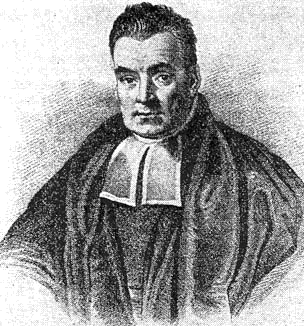
Thomas Bayes was born around 1701, the son of a London Presbyterian minister. He studied logic and theology at the University of Edinburgh, then preached at the Mount Sion Chapel in Tunbridge Wells until 1752. In his lifetime he published just two works: one defending the happiness of God's creatures, and one defending the logical foundations of Isaac Newton's calculus against a skeptical bishop. He was elected a Fellow of the Royal Society in 1742, likely on the strength of that mathematics defense.
Late in life Bayes grew fascinated by probability. He worked out a solution to a problem of inverse probability: given some observations, what can you infer about the hidden cause that produced them? Picture an urn of black and white balls. The easy direction asks the odds of drawing a black ball. Bayes asked the hard, backward direction: after drawing some balls, what can you now believe about how many of each color are in the urn? He never published it. After he died in 1761, his friend Richard Price edited the notes and read them to the Royal Society in 1763.
That backward reasoning is the engine of modern robotics. A robot never sees the world directly. It sees noisy sensor readings (a laser ping, a wheel tick, a camera frame) and must infer the hidden truth: where am I, and what is around me? Bayes' theorem is the recipe for blending a prior belief with new evidence to get a sharper updated belief. Run that update over and over and you get the Kalman filter, the particle filter, and SLAM (simultaneous localization and mapping), the techniques that let a self-driving car or a vacuum robot keep track of itself in a shifting world.
Bayes himself probably never imagined the sweeping interpretation that now bears his name. That broader view was pioneered by Pierre-Simon Laplace, and the word Bayesian only caught on around 1950. But his core insight (treat probability as a measure of belief that you revise as facts arrive) sits at the core of probabilistic machine learning, risk assessment, and state estimation. Robots think in exactly this way, one careful update at a time.
Fun facts
- His single most influential idea was published only after he died. Bayes left it unpublished in his notes, and his friend Richard Price shepherded it to the Royal Society two years after Bayes was gone, in 1763.
- His ideas later helped crack Nazi codes and hunt Cold War submarines. A popular history of his rule is literally titled The Theory That Would Not Die: How Bayes's Rule Cracked The Enigma Code, Hunted Down Russian Submarines, and Emerged Triumphant from Two Centuries of Controversy.
- The only known portrait said to be of Bayes is of doubtful authenticity, and even his exact birthday is unknown because he was baptised in a Dissenting church whose records did not survive.