Sebastian Thrun
1967-
The roboticist who taught machines to embrace their own uncertainty, then sent a driverless car named Stanley racing across the desert to win the DARPA Grand Challenge.
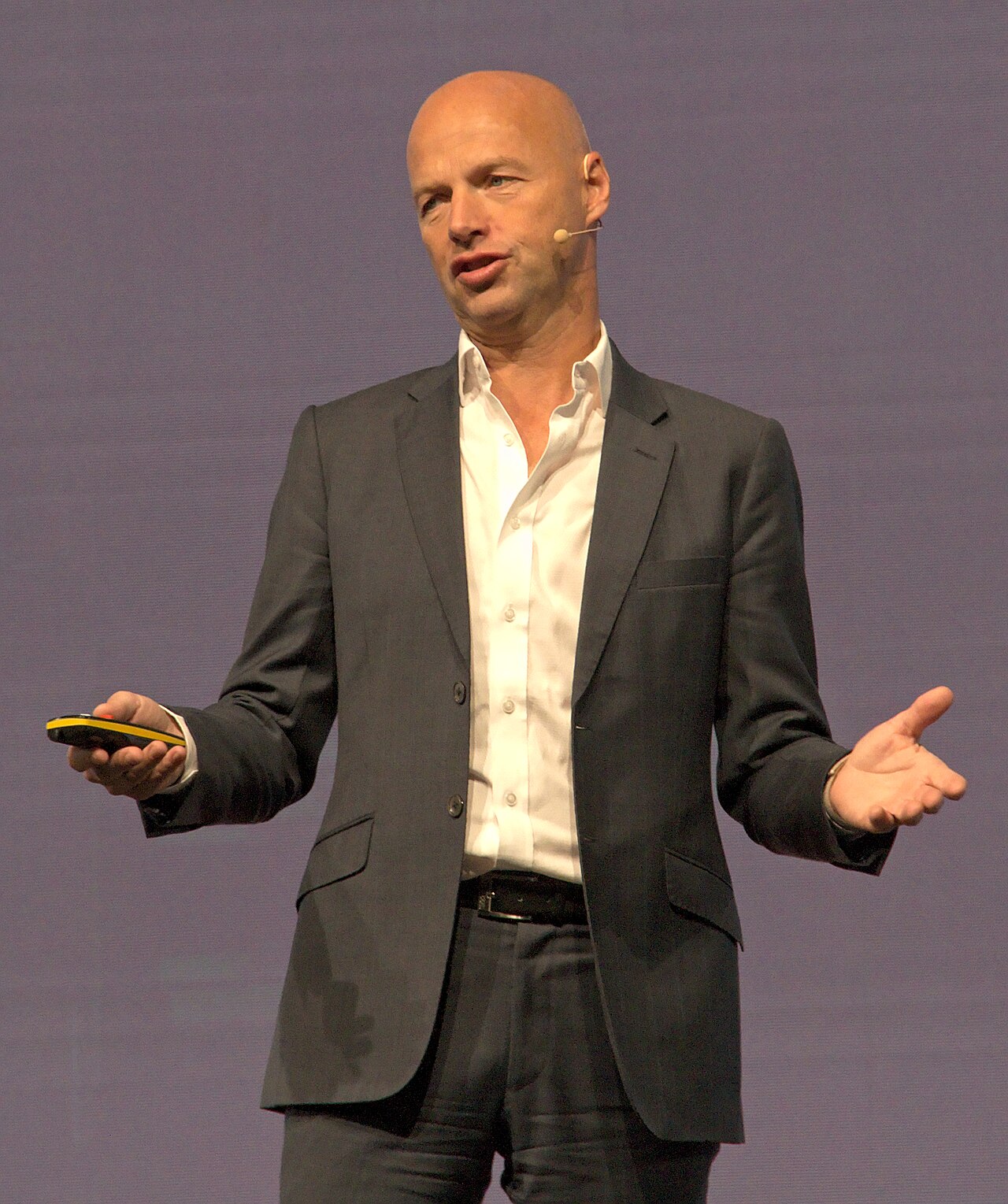
Sebastian Thrun was born in 1967 in Solingen, West Germany, and studied computer science, statistics, economics, and even a bit of medicine on his way to a PhD from the University of Bonn in 1995. He came up through the robotics scene at Carnegie Mellon University, then Stanford, where he ran the famous Stanford Artificial Intelligence Laboratory. Along the way he built a string of charming, useful robots: a tour guide that walked visitors through a museum in Bonn, its successor Minerva that guided tens of thousands of people through the Smithsonian, and a nursing-home assistant robot called the Nursebot.
His biggest contribution is more of an idea than a single machine. Thrun helped found the field of probabilistic robotics, which says a robot should never pretend it knows exactly where it is or what is around it. Instead it should track a cloud of possibilities and assign each one a probability, then update those odds every time a noisy sensor reading comes in. He pushed key methods like Monte Carlo localization (where thousands of guessed positions, called particles, compete and the wrong ones die off) and SLAM, simultaneous localization and mapping, where a robot builds a map and figures out its place in that map at the same time.
This matters because every real sensor lies a little: wheels slip, laser scans flicker, GPS drifts. Thrun's answer, captured in his 2005 textbook Probabilistic Robotics (written with Wolfram Burgard and Dieter Fox), was to treat the robot's belief about the world as a probability distribution and refine it with Bayesian math. That framework, blending statistics and state estimation, is now the standard toolkit. It is what let his car Stanley win the 2005 DARPA Grand Challenge and his follow-up car Junior take second in the 2007 Urban Challenge, and it became the foundation for the Google self-driving car project he went on to lead.
Thrun later turned that same restless energy toward people. He co-founded Google X, the moonshot lab, and co-created Google Street View. Then in 2012 he co-founded Udacity to bring free, large-scale online courses to the world, and he ran the flying-car company Kitty Hawk. He was elected to the National Academy of Engineering at just 39.
Fun facts
- His winning car Stanley did not retire to a garage. It now sits on display in the Smithsonian's National Museum of American History, in the same museum where his earlier robot Minerva once guided visitors as a tour guide.
- Back in 1997 he and his colleagues built what is considered the world's first robotic museum tour guide, deployed in a museum in Bonn, years before self-driving cars made him famous.
- He gave up a tenured professorship at Stanford in 2011 to join Google, and his papers on Monte Carlo localization were so influential they won both an AAAI Classic Paper Award and an ICRA Milestone Award years after publication.