Rudolf E. Kálmán
1930-2016
The Hungarian-American engineer whose Kalman filter taught machines to find a clear signal inside a flood of noisy measurements, the algorithm that guided Apollo to the Moon and still runs quietly inside almost every robot, drone, and GPS receiver.
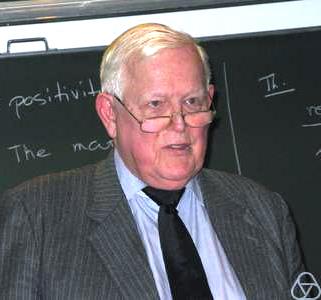
Rudolf Emil Kalman was born in Budapest in 1930 and emigrated to the United States in 1943. He studied electrical engineering at MIT, earning his bachelor's degree in 1953 and master's in 1954, then completed his doctorate at Columbia University in 1957. He spent his career moving between research and teaching, with stints at a Baltimore research institute, Stanford, the University of Florida (where he directed the Center for Mathematical System Theory), and ETH Zurich in Switzerland. He died in Gainesville, Florida, in 2016.
His signature idea, the Kalman filter, is a mathematical recipe for pulling a clean estimate out of a long stream of noisy or incomplete measurements. A sensor never tells you the exact truth: it gives you a number wobbling with error. The filter blends what you predict should happen next with what you actually measure, weighting each by how much you trust it, and updates its best guess step by step. It is the math behind knowing where you are when none of your sensors fully agree.
That is exactly the problem at the heart of robotics. A robot's wheels slip, its cameras blur, its gyroscopes drift, and its rangefinders return noise. State estimation, figuring out where the robot really is and how fast it is moving, is the Kalman filter's home turf, and it sits inside navigation systems, drones, self-driving cars, and GPS receivers to this day.
Kalman did more than invent one algorithm. In a series of papers in the 1960s he built the rigorous foundation of modern control theory, formally defining what a system is and introducing the now-essential ideas of controllability (can you steer a system where you want) and observability (can you figure out its hidden internal state from what you can measure). Every control engineer and roboticist still learns these concepts. His honors piled up accordingly, including the Kyoto Prize in 1985 and the U.S. National Medal of Science, presented by President Barack Obama in 2009.
Fun facts
- When Kalman first presented his filtering ideas, they were met with so much skepticism that he could not publish them in an electrical or systems engineering journal. He had to put his landmark 1960 paper in a mechanical engineering journal instead.
- The breakthrough that made the filter famous came from a 1960 visit to Stanley Schmidt at NASA Ames. That meeting led to the Kalman filter being used in the Apollo program, so the same math that engineers initially doubted ended up helping land humans on the Moon.
- His National Medal of Science citation credits the Kalman filter not just for the Moon landings but for being critical to creating the Global Positioning System, meaning his work is silently running every time your phone figures out where you are.