Rodney Brooks
1954-
The Australian roboticist who argued that a robot does not need to think before it acts, and proved it by building machines whose intelligence emerged from cheap, layered reflexes wired straight to the world.
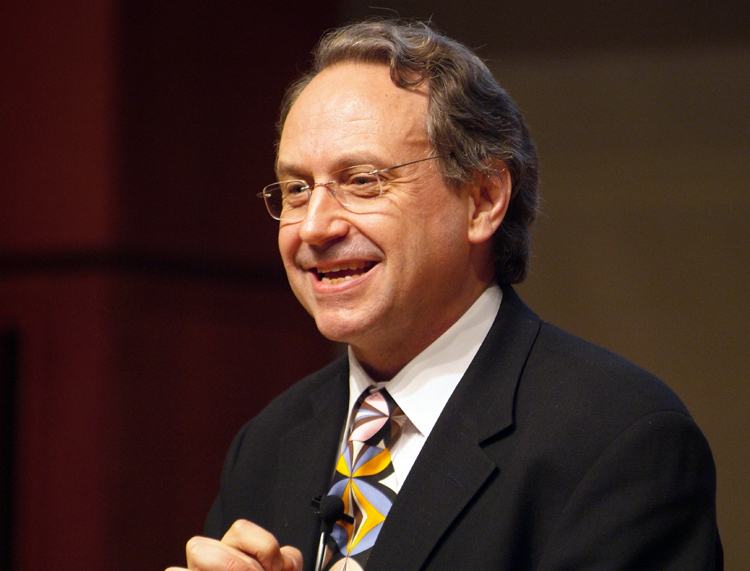
Rodney Brooks was born in Adelaide, Australia, in 1954. He earned a master's degree in pure mathematics at Flinders University, then crossed to the United States for a PhD in computer science at Stanford in 1981, working under the vision researcher Thomas Binford. After research stints at Carnegie Mellon and MIT, he joined the MIT faculty in 1984 and went on to direct the lab that became MIT's Computer Science and Artificial Intelligence Laboratory from 1997 to 2007.
His big idea was a rebellion against the way AI worked at the time. The dominant approach built a detailed internal model of the world, reasoned over it with symbols, then finally issued a command to move. Brooks called that backwards. In papers with titles like 'Elephants Don't Play Chess' and 'Intelligence without representation', he argued that real intelligence comes from being tightly coupled to the environment through sensors and motors, not from manipulating abstract symbols in a head. His robot Allen, in the late 1980s, ran on what he called subsumption architecture: simple behaviors (avoid obstacles, wander, explore) stacked in layers, each reacting directly to sensor readings, with higher layers nudging lower ones. Coherent behavior emerged from the stack without any central planner.
This matters to robotics because it reframed where competence lives. Instead of estimating a perfect world-state and then computing the one correct action, a Brooks robot lets the world be its own model and responds in tight, fast feedback loops. That insight runs straight through modern control and state estimation: keep the sensing-to-action loop short, trust continuous feedback over a brittle internal map, and layer simple controllers rather than betting everything on one giant plan. His own line about Pluto's orbit captures the spirit: you can describe a planet as 'computing' its path, but Newton's equations are simpler and truer, so use those.
Brooks turned theory into industry. He co-founded iRobot with former students Colin Angle and Helen Greiner, helping launch both consumer robots and machines that searched the rubble at Ground Zero in New York. He later founded Rethink Robotics, whose robot Baxter (2012) was built to work safely beside humans: it stops if its arm meets a person and has a big obvious off switch. In 2019 he co-founded Robust.AI, which introduced the mobile robot Carter. Even now he is a skeptic of hype, warning publicly in 2024 that people vastly overestimate what generative AI can actually do.
Fun facts
- Brooks tried to make robots reproduce. He experimented with off-the-shelf Fischertechnik and Lego parts and attempted to get robots to self-replicate by assembling clones of themselves from the components.
- He and his behavior-based robots became film stars: the 1997 documentary 'Fast, Cheap & Out of Control' featured his work, weaving his robots together with a topiary gardener, a mole-rat keeper, and a lion tamer.
- The co-founder of iRobot, maker of the Roomba, started out in pure mathematics, not engineering, and his TED talks bluntly promised that 'robots will invade our lives' (2003) and that 'we will rely on robots' (2013).