Pierre-Simon Laplace
1749-1827
The French mathematician who turned the chaos of the heavens into clean equations, and along the way invented half the toolkit a modern robot uses to reason, transform signals, and guess where it is.
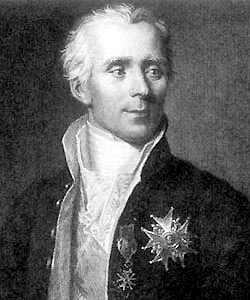
Pierre-Simon Laplace was born in 1749 in a small village in Normandy, the son of a farmer and cider merchant who expected him to become a priest. He studied theology at the University of Caen, discovered he was far better at mathematics, and at around 22 walked into Paris with a letter of introduction. The story goes that the great mathematician d'Alembert brushed him off with a thick textbook, then was stunned when the young man came back having mastered it. Laplace got a teaching post, and for the next several decades he became, by many accounts, the most powerful mathematical mind in France: nicknamed the Newton of France, examiner of a young cadet named Napoleon, and briefly Minister of the Interior (a job he was, by Napoleon's account, terrible at).
His great obsession was the Solar System. Newton himself had worried that the planets, tugging on each other over centuries, would eventually fall out of balance, and suggested God might have to step in now and then to fix it. Laplace set out to prove the math could explain the stability on its own. In his five-volume Celestial Mechanics he translated Newton's clumsy geometry into the smooth language of calculus, which let him chase down subtle effects everyone else had thrown away as too small. That same instinct, take a hard physical problem and find the right mathematical machine to crack it, produced an astonishing pile of tools that still carry his name.
This is where Laplace reaches straight into robotics. The Laplace transform turns messy differential equations (the kind that describe a motor, a spring, or a wobbling arm) into simple algebra, and it is the backbone of how control engineers analyze and tune systems today. The Laplacian operator shows up everywhere from sensor smoothing to the graphs that describe how robots in a swarm are connected. And his work on the gravitational potential gave engineers the idea of describing a whole field of forces with one simple scalar function, an idea echoed in the potential fields robots use to navigate around obstacles.
Even bigger is his work on probability. Laplace independently built and popularized what we now call Bayesian reasoning: a precise rule for updating your belief about an unknown cause as new evidence comes in. That is exactly what a robot does when it fuses noisy sensor readings to estimate where it is, and it sits at the heart of modern state estimation and the filters that power self-driving cars and drones. He also proved an early version of the central limit theorem and connected probability to the method of least squares, the workhorse of fitting models to noisy data. In short, much of the math a robot uses to handle uncertainty traces back to one man trying to predict the motion of the planets.
Fun facts
- Laplace imagined what is now called Laplace's demon: a hypothetical intellect that, if it knew the exact position and motion of every particle in the universe, could compute the entire future and past in a single formula. It was one of the first clear statements of a fully deterministic, clockwork universe, and it is still argued over by physicists and philosophers today.
- When Napoleon asked why his huge book on the universe never mentioned God, Laplace is said to have replied, 'I had no need of that hypothesis.' The exact wording is disputed, but the point stuck: he believed the laws of nature could explain the system on their own, without divine tinkering.
- Laplace died on the same day as Alessandro Volta in 1827. His doctor removed his brain, which then toured Britain in a traveling anatomy show, and it was reportedly smaller than average, an awkward footnote for one of history's most formidable minds.