Oussama Khatib
1951-
The Stanford roboticist who taught machines to think in the space of the task, not the tangle of their own joints, turning robot control into a problem of physics and forces rather than guesswork.
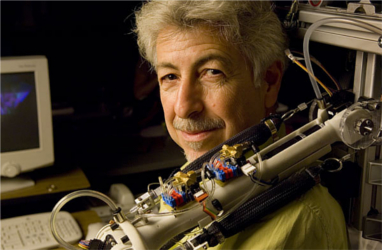
Oussama Khatib was born in Aleppo, Syria, in 1950. He earned his Ph.D. in electrical engineering from Sup'Aero in Toulouse, France, in 1980, then crossed the Atlantic to join the Computer Science Department at Stanford University, where he has been on the faculty ever since. Today he directs the Stanford Robotics Laboratory and is part of the university's Bio-X Initiative, which blends engineering with biology and medicine.
His first big idea came in 1978: the artificial potential field method. Instead of solving the brutally hard problem of planning a whole path in advance, he imagined the robot moving through an invisible landscape of forces, drawn toward its goal like a marble rolling downhill and pushed away from obstacles as if they were hilltops. The robot just follows the slope. It was a way to make robots react in real time to messy, unpredictable surroundings, and the trick spread far beyond robotics into computer graphics, vision, and animation.
His second landmark, the operational space formulation (1980), is the one that quietly reshaped how robot arms are controlled. Most robots were commanded joint by joint, like puppeteering each elbow and wrist separately. Khatib instead wrote the math directly in the space where the task actually lives: where the hand needs to go and how hard it should push. Paired with an accurate model of the robot's mass and inertia, this lets a complex arm coordinate all its joints in the most energy-efficient way possible, while smoothly blending motion and force. This is why a robot can wipe a surface, open a door, or work safely alongside a human without fighting itself.
Over the decades his lab pushed into cooperative robots, whole-body control of humanoids, and haptics: the technology of touch. With his students he built virtual proxies that let people feel virtual objects, and even a haptic interface that works inside an MRI scanner so neuroscientists can study how the brain controls the hand. He co-edited the Springer Handbook of Robotics, was elected to the National Academy of Engineering in 2018, and was made a Knight of France's National Order of Merit in 2023.
Fun facts
- His potential field idea is so intuitive it has escaped robotics entirely: video game characters, animated crowds, and computer vision systems all borrow the same trick of steering things with invisible attractive and repulsive forces.
- His lab built a haptic device that can operate inside a working MRI machine, letting a person reach out and feel virtual objects while a scanner watches their brain in real time, quiet enough to study a single person without blurring the data.
- His Stanford robots had names: a pair of pioneering mobile manipulators called Romeo and Juliet, whose models and algorithms later fed into work on famous humanoids like Honda's ASIMO.