Oliver Heaviside
1850-1925
A self-taught Victorian telegraph operator who taught himself advanced math from scratch and rewrote Maxwell's electromagnetism into the four compact equations every engineer still uses, while inventing the operator-based shortcut for solving differential equations.
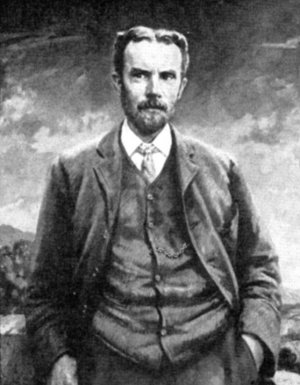
Oliver Heaviside was born in Camden Town, London, in 1850, the youngest of three children of a wood engraver. Scarlet fever as a child left him with a hearing impairment, and his family was too poor to keep him in school past age 16. He had no further formal education. He went to work as a telegraph operator, helping lay an undersea cable between Newcastle and Denmark, and taught himself mathematics on the side. When he first read Maxwell's giant Treatise on Electricity and Magnetism, he later recalled having no knowledge of mathematical analysis at all, only half-forgotten school algebra and trigonometry. It took him several years to master the book, and then, in his words, he set Maxwell aside and followed his own course.
His most lasting gift to engineers is hidden in plain sight. Maxwell originally wrote electromagnetism as 20 equations in 20 variables. In 1884 Heaviside, using the vector calculus tools he helped develop (curl and divergence), boiled them down to the four compact equations in terms of the electric and magnetic fields that everyone now calls Maxwell's equations. He coined a whole vocabulary engineers still use every day: impedance, inductance, conductance, permeability, permittivity, and reluctance.
Here is why a roboticist should care. To solve the differential equations that describe circuits, Heaviside invented his operational calculus, treating the act of differentiation as an algebraic symbol you could shuffle around like any other number. That turns hard calculus problems into ordinary algebra, which is exactly the trick (later made rigorous and renamed the Laplace transform) behind transfer functions, the s-domain, and the whole language of classical control theory used to tune motors, servos, and feedback loops. He also invented the Heaviside step function (the mathematical on switch) and was the first to use the unit impulse now known as the Dirac delta, two building blocks of how control engineers and signal processors model and test systems today.
He worked from home as an independent, was chronically poor, and was often at odds with the scientific establishment, especially a Post Office official named Preece who blocked his correct insight that adding inductance to a line would reduce distortion. His transmission line theory (the telegrapher's equations) eventually sped up cable transmission roughly tenfold. He turned down money from AT&T because the company would not give him full recognition, accepted a small government pension only after friends persuaded him, and grew increasingly reclusive, reportedly delivering his manuscripts to a grocery store for his editors to collect. Most of his wider fame came after his death in 1925, following a fall from a ladder.
Fun facts
- He predicted a reflecting layer high in the atmosphere that bounces radio signals around the curve of the Earth. It was confirmed years later and named the Kennelly-Heaviside layer, and the scientist who finally proved it existed won a Nobel Prize in 1947. T. S. Eliot's poem about a magical cat that vanishes into the upper air, the Heaviside Layer in the musical Cats, is named after this very idea.
- Defending his loose, unrigorous math against critics who complained it was not properly justified, he shot back: Shall I refuse my dinner because I do not fully understand the process of digestion? His operator method worked beautifully for decades before mathematicians caught up and proved why.
- He was one of the only first-rate physicists of his era to publicly reject Einstein's relativity, his late behavior turned eccentric (he signed letters with the initials W.O.R.M., painted his fingernails pink, and furnished his house with granite blocks), and back in 1893 he sketched an electromagnetic-style analogy for gravity that anticipated effects only confirmed by the Gravity Probe B satellite in 2005.