James Clerk Maxwell
1831-1879
The Scottish physicist who proved light is an electromagnetic wave, and who, almost as a side project, wrote the first real mathematics of feedback control: the equations that still govern how a robot keeps itself stable.
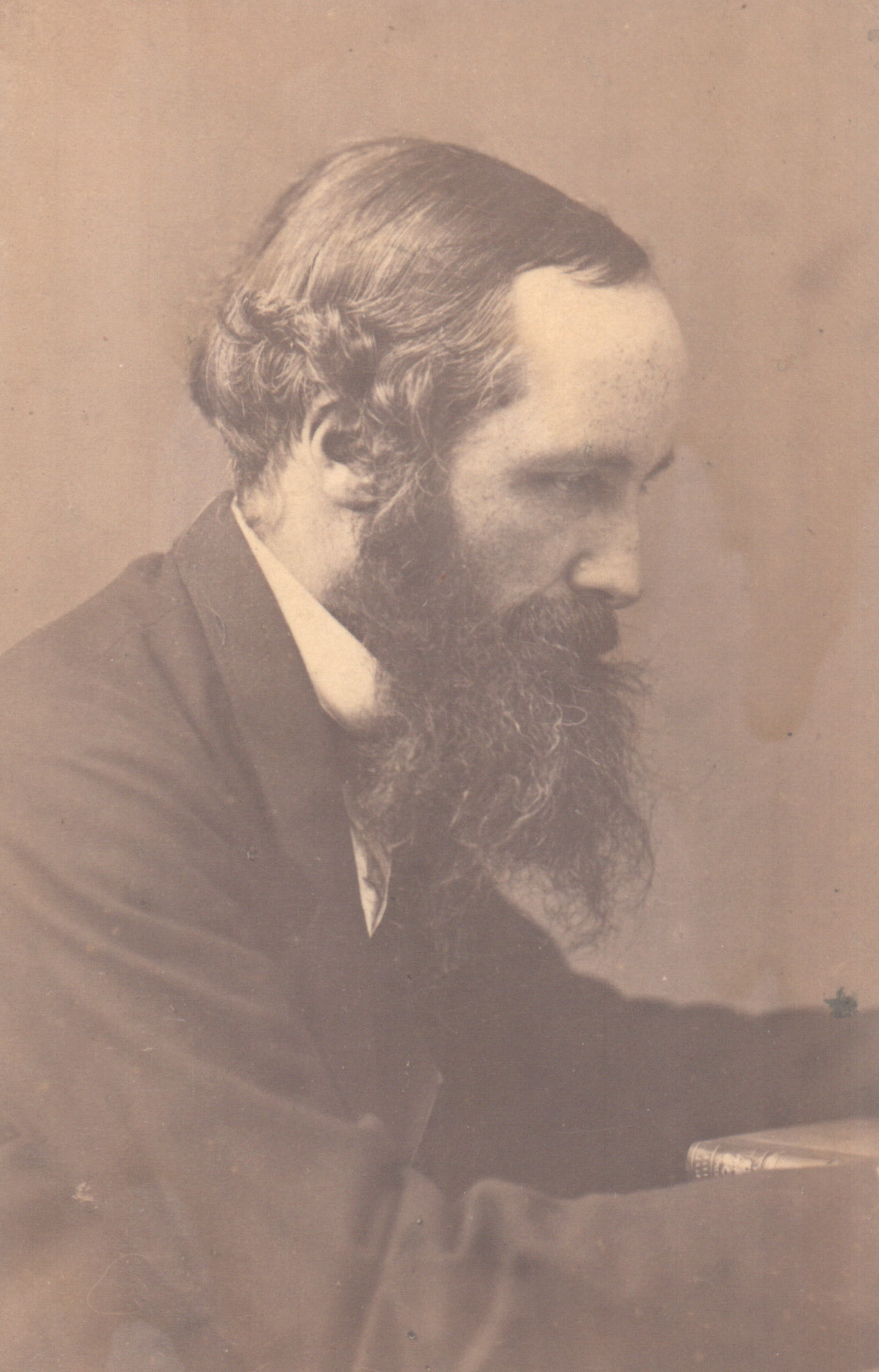
James Clerk Maxwell was born in Edinburgh in 1831 into a comfortable family and grew up on a country estate in Galloway, where as a toddler he pestered everyone with the same question about anything that moved, shone, or made a noise: "what's the go o' that?" That curiosity never switched off. He wrote his first scientific paper at fourteen, was twice judged too young to read his own work aloud to the Royal Society of Edinburgh, and went on to Cambridge, where he graduated in 1854 near the top of his class.
His headline achievement was unifying electricity, magnetism, and light. Building on Michael Faraday's ideas, Maxwell showed mathematically that electric and magnetic fields ripple through space as waves moving at the speed of light, which meant light itself was an electromagnetic wave. The set of relationships now called Maxwell's equations predicted radio waves before anyone had detected them, and they are why he is regarded as a founder of modern electrical engineering. He also derived the Maxwell-Boltzmann distribution, a cornerstone of statistical mechanics that describes how the speeds of gas molecules are spread out, one of the first times physics described a system in terms of probabilities rather than certainties.
The reason Maxwell belongs in a robotics book is a short 1868 paper called On Governors. A governor is the spinning mechanical device that kept early steam engines from racing out of control, and Maxwell was the first to analyze, with calculus, why some of these feedback loops settled down smoothly while others oscillated wildly or shook themselves apart. That paper is widely treated as the founding work of control theory and a direct ancestor of cybernetics. Every robot that senses its own state, compares it to a goal, and corrects the error is running the kind of feedback loop Maxwell first put into equations.
His instinct for systems that wobble ran deep. He was among the first to grasp what we now call chaos, noting that some systems show sensitive dependence on initial conditions, and he emphasized the butterfly effect a century before it had that name. Maxwell died of abdominal cancer in 1879 at just 48, the same age and the same illness that had taken his mother. In one short life he handed later engineers both the electromagnetic theory that powers a robot's motors and sensors and the mathematics of stability that keeps the whole machine from tearing itself to pieces.
Fun facts
- In 1861 Maxwell produced the world's first durable color photograph, and the method behind it is still with us. He showed that any color can be made by mixing red, green, and blue light, which is exactly the RGB principle inside every screen, camera, and color television.
- He spent two years proving that Saturn's rings could not be solid or liquid and must instead be countless tiny particles, which he cheerfully called "brick-bats." A reviewer called it one of the most remarkable applications of mathematics to physics he had ever seen, and the Voyager flybys of the 1980s confirmed Maxwell was right.
- He invented Maxwell's demon, a thought experiment about a tiny gatekeeper sorting fast and slow molecules, which forced physicists to ask how information itself relates to entropy. It quietly anticipated the deep link between information and physics that underpins modern computing.