Hendrik W. Bode
1905-1982
The Bell Labs engineer whose frequency-response plots gave the world a fast, intuitive way to ask the question every control system lives or dies by: will this feedback loop stay stable?
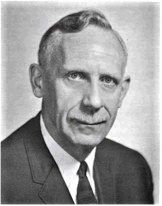
Hendrik Wade Bode was born in Madison, Wisconsin in 1905 and turned out to be the kind of prodigy who finishes high school at 14. The University of Illinois actually rejected him for being too young (decades later, in 1977, they gave him an honorary doctorate). He studied mathematics at Ohio State, earning his bachelor's at 19, then was hired straight out of school by Bell Labs in New York, where he spent more than four decades designing electronic filters, amplifiers, and the math behind them. Bell sponsored him through a physics PhD at Columbia, finished in 1935.
His most famous gift to engineers came in 1938: a pair of plots, now called Bode plots, that show how a system responds across a range of frequencies, one curve for how much it amplifies or shrinks a signal (gain) and one for how much it delays it (phase). The trick was that he let you judge stability in the frequency domain, which turned out to be far faster and more intuitive than slogging through the time domain. From these plots come the ideas of gain margin and phase margin: simple numbers that tell you how much breathing room a feedback loop has before it starts to oscillate out of control.
This is the bedrock of robotics and control. Every motor that has to hold a position, every drone that has to stay level, every robot arm that must not overshoot and shake itself apart is a feedback loop, and Bode's margins are how engineers check that the loop will settle instead of going unstable. During World War II he turned this work toward radar-guided anti-aircraft guns, building what he half-jokingly called a 'shotgun marriage' of wireless data, early computers, statistics, and feedback control. The result, an automatic gun that sensed a target, predicted where it would be, and fired, is arguably one of the first robot weapons, and it helped shoot down V-1 flying bombs over London.
When he redesigned the gun director, he replaced noisy calculus-style differentiation with a finite-difference scheme that stored past positions and compared them, the so-called backward difference. That made tracking twice as accurate and twice as fast, and it is essentially the same backward-difference idea at the heart of modern digital control and digital signal processing. After the war he kept working on missiles and anti-ballistic systems, helped advise the early US space effort, retired from Bell Labs in 1967, then became a professor at Harvard. He died in 1982; in 1989 the IEEE Control Systems Society named its top lecture prize after him.
Fun facts
- The automatic anti-aircraft guns Bode helped build made London, in his collaborators' words, the original robot battlefield. In one stretch of summer 1944 the radar-and-feedback gun crews knocked down over a thousand V-1 flying bombs.
- In a twist of history, Bode later sat at the same committee table as Wernher von Braun, the German rocket engineer behind the very V weapons that Bode's robot guns were built to destroy. Both served on the space-technology committee that fed into the founding of NASA.
- Long before he was a control-theory legend, Bode co-wrote a piece of fiction with his wife Barbara called 'Counting House,' published in Harper's Magazine in August 1936. He collected 25 patents over his career, spanning everything from electronic filters to artillery computers.