Edward Routh
1831-1907
The legendary Cambridge math coach who, almost as a side project, wrote down the algebraic test engineers still reach for to ask one make-or-break question: will this system stay stable, or shake itself apart?
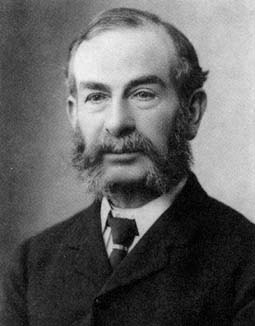
Edward John Routh was born in Quebec City in 1831 to an English father and a French-Canadian mother, and came to England at age eleven. He studied under Augustus De Morgan in London, then went to Peterhouse, Cambridge, where in 1854 he was named Senior Wrangler, the top math graduate of his year, finishing just ahead of James Clerk Maxwell and sharing the Smith's Prize with him.
What made Routh famous in his own time was teaching. As a private tutor he coached over 600 students between 1855 and 1888, drilling them in rigidly timetabled classes and preparing extra material at night for his strongest pupils. Twenty-eight of them became Senior Wrangler, an unbeaten record. His students included future giants like Lord Rayleigh, J. J. Thomson, and George Darwin. He was so devoted to competition that when Cambridge began listing exam results alphabetically he grumbled they would want to run the Derby alphabetically next.
Behind the coaching, Routh did serious original work in mechanics and stability. His textbook on the dynamics of rigid bodies helped define the modern mathematical approach to mechanics and influenced figures like Klein, Sommerfeld, and Kelvin. He also developed what is now called Routhian mechanics and highlighted ignorable coordinates, the variables that quietly conserve momentum and make hard problems tractable.
His deepest gift to robotics and control came from a single question: given the equations of a moving system, will it settle down or blow up? Routh turned that into the Routh stability criterion, a purely algebraic procedure that reads stability straight off a system's characteristic polynomial without ever solving for its roots. Today that result, paired with later work as the Routh-Hurwitz criterion, is foundational to control systems theory. Every time an engineer checks whether a feedback loop on a drone, a robot arm, or a balancing machine will stay stable, they are using the machinery Routh built.
Fun facts
- He beat the legend. In the 1854 Tripos, Routh was ranked Senior Wrangler just above James Clerk Maxwell, the man who would later unify electricity and magnetism. The future titan of physics came in second to the coach.
- Love cost him his job. When Routh married Hilda, the daughter of the Astronomer Royal George Airy, Cambridge still demanded that fellows stay celibate, so he had to give up his fellowship. Years later, after the rule was scrapped, Peterhouse made him the very first person it elected to an honorary fellowship.
- The criterion that anchors modern control theory is, at heart, an old algebra trick: Routh's stability test is an application of Sturm's theorem using the Euclidean algorithm, the same root-counting idea generations of students learned, repurposed to predict whether a machine will hold steady.