Edsger W. Dijkstra
1930-2002
The Dutch computer scientist who, in 1956, dreamed up the shortest-path algorithm that still guides robots, GPS, and network routers through the cheapest route from here to there.
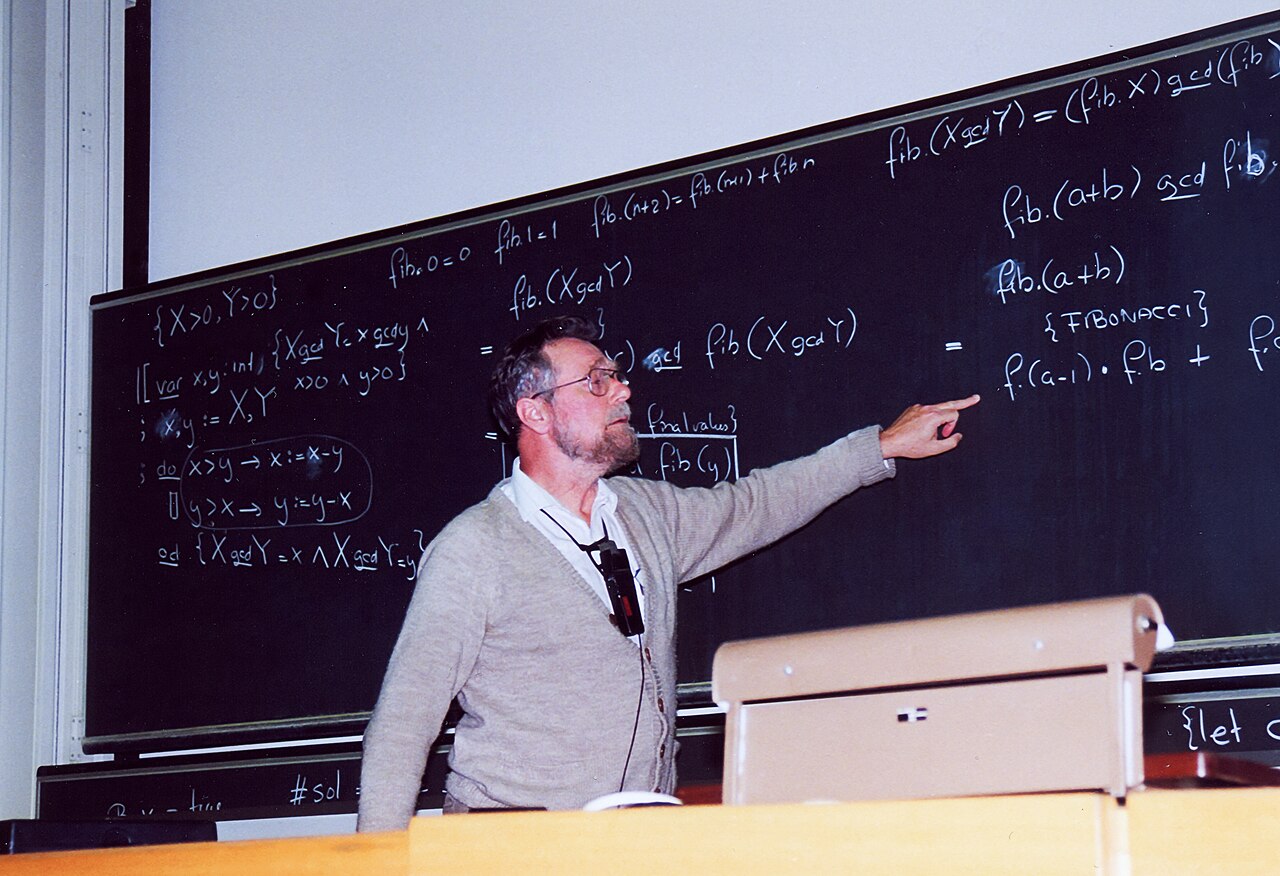
Edsger Wybe Dijkstra (1930 to 2002) was born in Rotterdam to a chemist father and a mathematician mother. He studied physics at the University of Leiden, but a chance meeting pulled him into the brand-new world of computing: in March 1952 he officially became the first 'programmer' in the Netherlands. The job was so new that when he married in 1957 and wrote 'programmer' as his profession, the authorities rejected it because no such job existed yet. After a long talk with his boss about whether programming could ever be a respectable discipline, Dijkstra decided to spend his life making it one.
His most famous idea came in 1956, when he was asked to show off a new computer at a public demonstration. To do it he invented what is now called Dijkstra's algorithm: a clean, efficient way to find the shortest path through a network of points and connections. He reportedly worked it out in his head in about twenty minutes while sitting at a cafe with his fiancee. He did not even publish it until 1959, because there were no journals for computing yet.
That single idea is woven through modern robotics. A robot deciding how to cross a room, a self-driving car choosing a route, and a delivery drone planning a path all face the same problem Dijkstra solved: given many possible moves with different costs, find the cheapest way from start to goal. His algorithm guarantees the truly shortest path, and it is the foundation that later planners (like A*) build on. The same math even routes the internet, through protocols such as OSPF and IS-IS.
Beyond path-finding, Dijkstra shaped how careful, reliable systems are built. He won the 1972 Turing Award for championing 'structured programming', argued famously that the 'go to' statement was harmful, and invented tools like the semaphore for coordinating processes that run at the same time, exactly the kind of concurrency a robot's many sensors and motors demand. He believed simplicity and elegance were not luxuries but, in his words, 'a matter of life and death' when systems get complex.
Fun facts
- Dijkstra distrusted computers in his own work. For decades he wrote everything by hand with a Montblanc fountain pen, never used a word processor, and even after colleagues talked him into buying a Macintosh he used it only for email and browsing the web.
- He circulated nearly 500 hand-numbered manuscripts known as the 'EWD' series, after his initials. People photocopied and forwarded them so widely that they spread across the global computer science community as a kind of pre-internet viral newsletter.
- He had a sharp, mischievous wit. One of his most quoted lines is that asking whether machines can think is 'about as relevant as the question of whether submarines can swim.'