Carl Friedrich Gauss
1777-1855
The German prodigy who turned a few scraps of stargazing into the method of least squares, the bell curve, and the recursive estimation math that lets a robot guess where it is from noisy, incomplete sensor data.
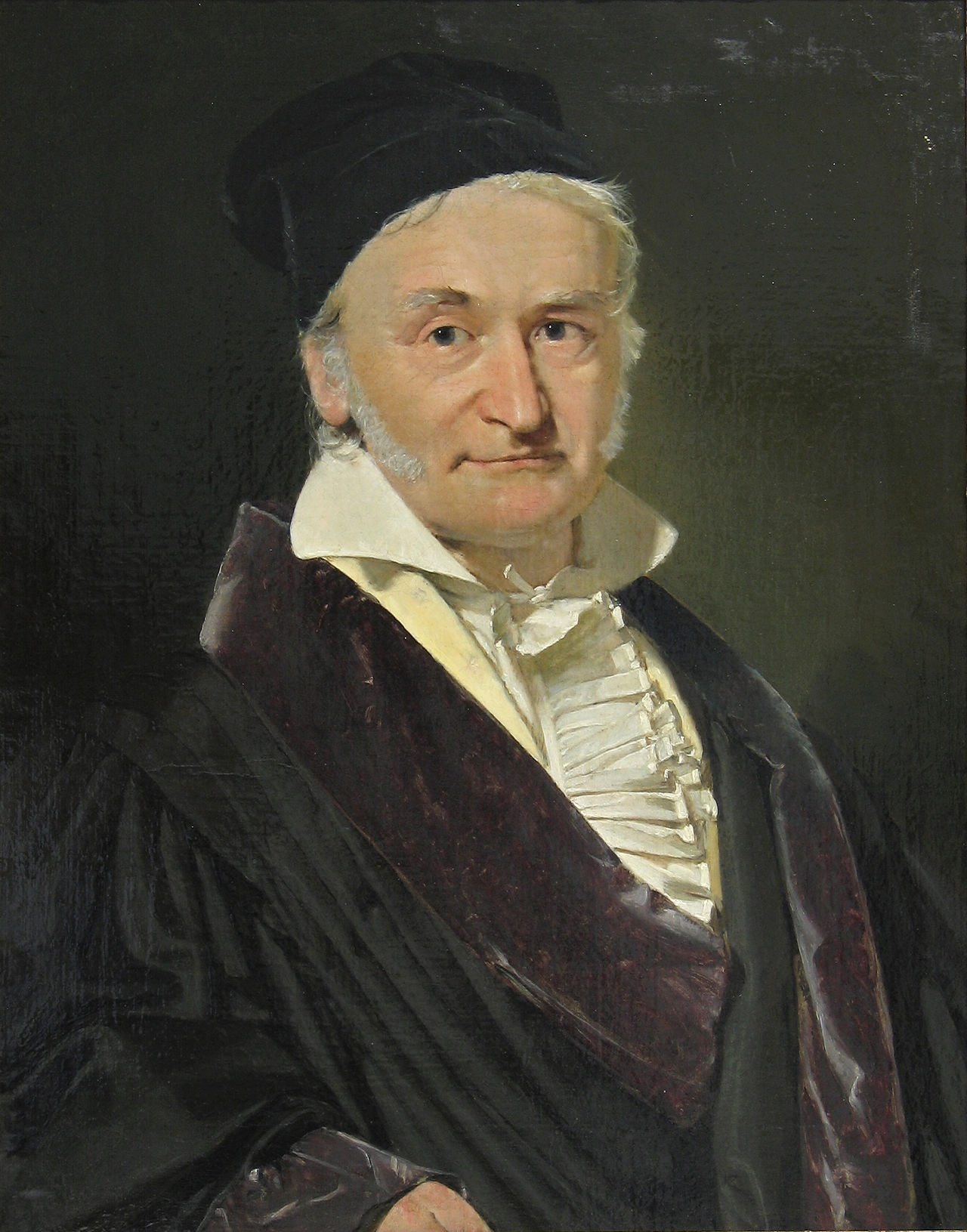
Born in 1777 in Brunswick to a poor family (his father was a butcher and bricklayer, his mother nearly illiterate), Carl Friedrich Gauss was a child prodigy who reportedly summed the numbers 1 to 100 in seconds by pairing them into fifties. A local duke spotted his talent and paid for his schooling. At 19 he figured out which regular polygons can be drawn with just a compass and straightedge, solving a problem open since ancient Greece, and that thrill pushed him to choose mathematics over languages as a career.
His fame exploded in 1801 over a vanished dwarf planet. The astronomer Giuseppe Piazzi had spotted Ceres, tracked it briefly, then lost it in the Sun's glare with only a handful of observations to go on. Nobody could predict where it would reappear. Gauss did, and his prediction was accurate to within half a degree. To pull this off he leaned on the method of least squares, a way of fitting a model to noisy measurements so that the total squared error is as small as possible. He later proved (in the Gauss-Markov theorem) that under normally distributed errors this method gives the best possible linear unbiased estimate.
That story is, in miniature, the whole problem of robotics: estimate a hidden state (where am I, where is that object, what is its trajectory) from sensor readings that are noisy, partial, and never quite agree. Gauss gave engineers the core tools. Least squares is the engine behind GPS fixes, camera calibration, and the bundle adjustment inside visual SLAM. The normal distribution he popularized (the bell curve, often just called Gaussian) is how robots represent uncertainty in their own position and in what they sense. His Gaussian elimination is still the standard way to solve the linear systems these estimators produce.
Crucially, Gauss also described recursive least squares: a way to update an estimate as each new measurement arrives, without recomputing everything from scratch. That idea is the direct ancestor of the Kalman filter, the algorithm running in essentially every drone, self-driving car, and spacecraft to fuse sensor streams in real time. Gauss spent his later decades surveying the Kingdom of Hanover, founding the study of curved surfaces, measuring Earth's magnetic field, and building (with Wilhelm Weber) one of the first electric telegraphs. He died in 1855 in Göttingen, leaving more than 100 ideas that carry his name.
Fun facts
- Gauss worked out a fast Fourier transform around 1805 while crunching asteroid orbits, roughly 160 years before Cooley and Tukey rediscovered the algorithm that now powers nearly all digital signal processing. He never bothered to publish it; the paper surfaced only after his death.
- His brain was removed and preserved the day after he died and studied for over a century. In 2013 researchers discovered it had been mixed up due to a mislabeling with the brain of a physician who died in Göttingen a few months later, meaning most studies of 'Gauss's brain' were actually of the wrong man.
- Gauss refused to publish anything he considered incomplete, his personal motto being roughly 'few, but ripe.' This perfectionism delayed the spread of many discoveries for decades, and rivals sometimes got public credit for ideas his private diaries show he had reached first.