Pheromones & Stigmergy
How a colony solves problems no single ant could
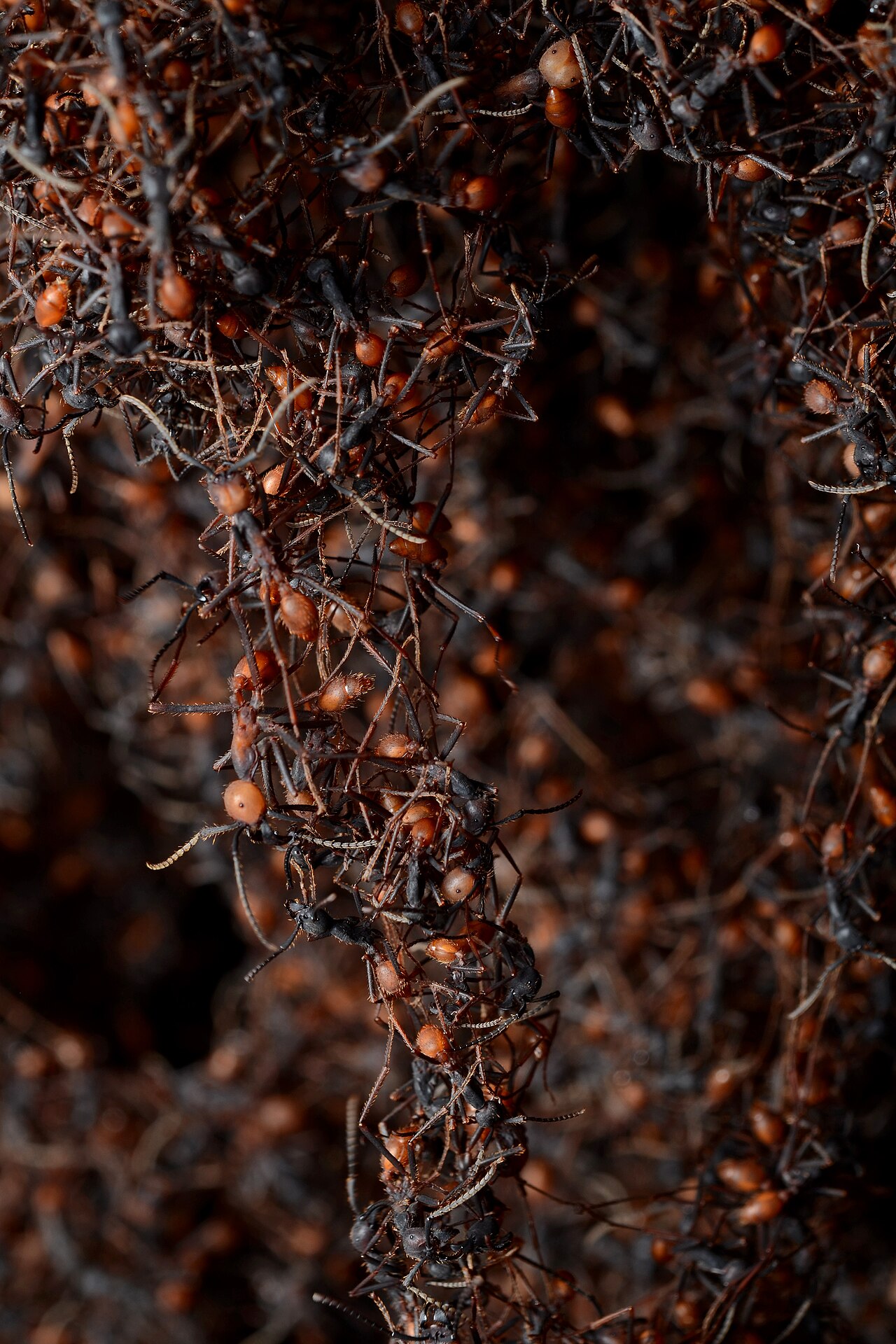
A single ant is almost insultingly dumb. A colony of them finds the shortest path to food, builds bridges out of its own bodies, and farms fungus. Nobody is in charge. So who is doing the thinking?
The answer is one of the most beautiful ideas in robotics: the environment does the thinking. Each ant leaves a chemical trace, reads the traces others left, and acts on what it smells right now. Coordination happens in the dirt, not in the head. The demo below lets you run a tiny colony and watch a trail solve a maze it doesn’t know it’s in.
pheromone 0 · ants 0 · carrying 0
walls block the ants and the scent, so the colony has to route around the maze; drag the food (or nest) marker to relocate it.
Drag the sliders, then watch a trail carve itself between the nest and the food, and read the predictions below before you check them against what you see.
Try this:
- Let it run untouched. Wandering at first, then a bright channel snaps into focus. That channel is the colony’s answer, written in scent.
- Crank up decay. The trail evaporates faster than the ants can refresh it, and the swarm forgets, dithering forever. Too little memory.
- Drop decay to near zero. Now an old, bad route never fades, so the colony stubbornly clings to it even when a shorter one opens. Too much memory. The magic lives in the balance.
Coordination without conversation
There is a word for this: stigmergy, coined by the French biologist Pierre-Paul Grassé in 1959. It means coordination by leaving traces in the environment rather than by talking. An ant doesn’t message its sisters “food is northeast.” It drops a molecule and walks on. The next ant that crosses the molecule turns toward the stronger smell. Multiply by a million and you have a colony that behaves with eerie purpose, built entirely from agents that never agreed on anything.
This matters enormously for robots. Direct communication does not scale: a hundred robots all broadcasting positions to each other is a network nightmare. But a shared field (a map of pheromone the robots write and read locally) scales to any number of agents, because each one only ever talks to the patch of ground beneath it.
Why the shortest path wins
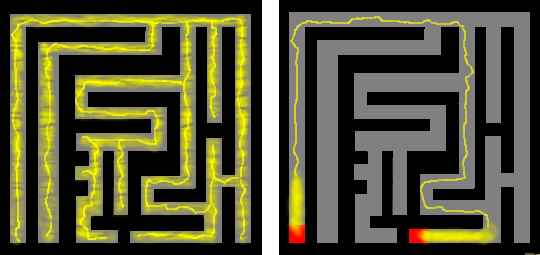
Here is the trick that turned biology into algorithms. Ants lay pheromone as they travel, and the chemical slowly evaporates. Now imagine two routes from nest to food, one short, one long. Ants on the short route complete the round trip sooner, so they re-deposit more often, so their trail builds faster than it decays. The long route can’t keep up; its scent fades. Within minutes the colony has converged on the shortest path, with no map, no measurement, and no boss.
That is the whole secret of the demo above. Reinforcement plus decay, racing each other on every route, and the geometry sorts itself out.
Biologists didn’t just assume this; they built a tiny test track for it. In the late 1980s a group in Brussels gave Argentine ants a bridge that split into two arms of unequal length, both joining the nest to the food. With nothing but the deposit-and-decay race, the colony reliably ended up funnelling almost all its traffic down the shorter arm. It became known as the double-bridge experiment, and it is the closest thing the field has to a clean proof that the shortest path really does fall out of the chemistry alone.
Termites, with no architect
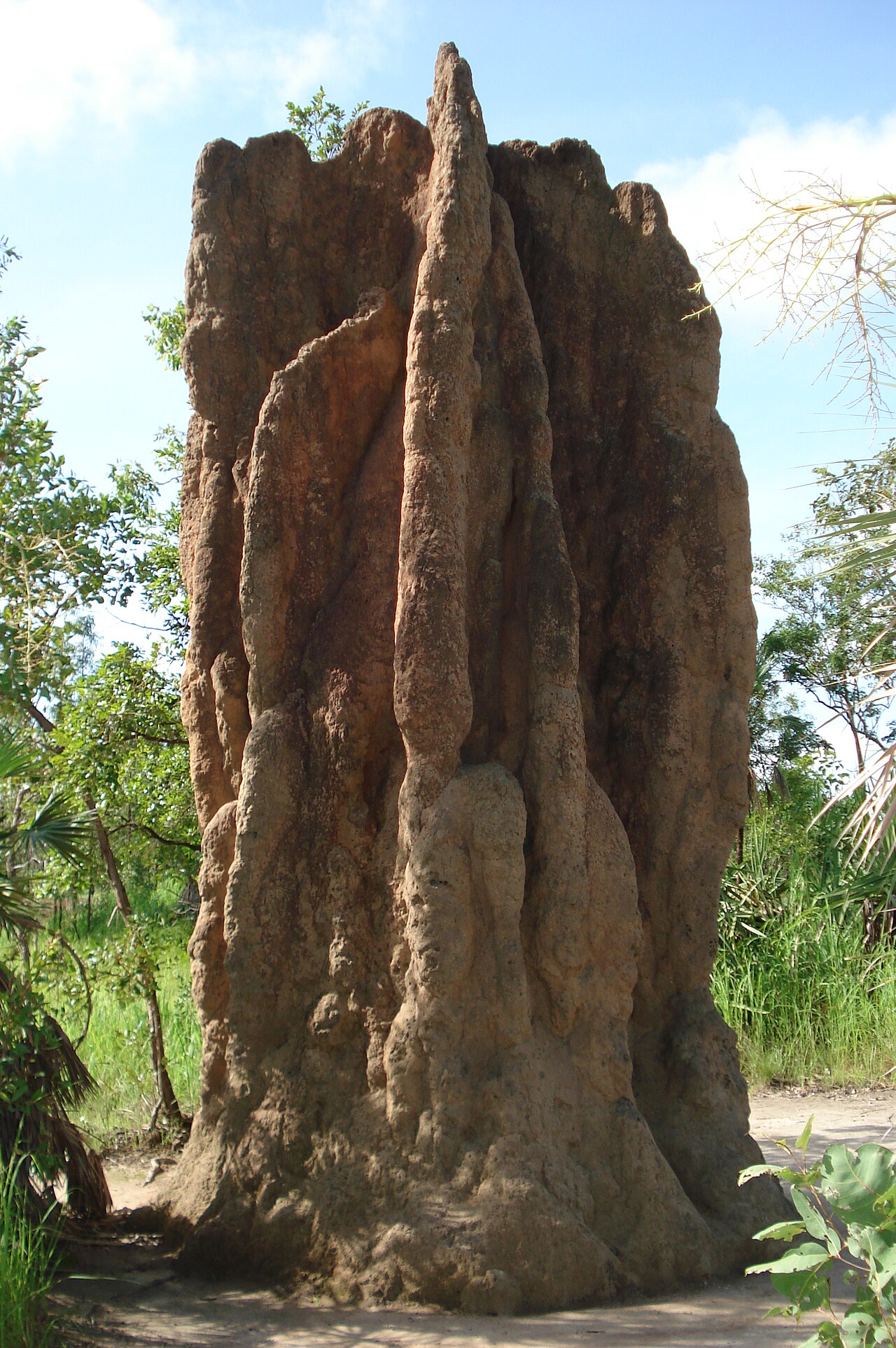
The mound in the cold-open is the showpiece. Termites raise metre-tall cathedrals (taller, relative to their bodies, than anything humans build) with internal chimneys that ventilate the colony like a passive lung. No termite holds the plan, because there is no plan. Each one follows a local rule: pick up a grain of soil, and prefer to drop it where the scent of other deposits is strongest. Mounds of mud attract more mud. Pillars rise, arch toward their neighbours, and fuse into vaults. The architecture is a consequence of the rule, not an instruction obeyed.
This is the dream for swarm robotics. Give each robot a dead-simple local rule and a way to read and write a shared field, and let coherent global structure fall out for free.
The math: deposit, decay, diffuse
We model the pheromone as a scalar field over space, evolving in continuous form as
Three forces, and only three. The decay term makes scent evaporate everywhere at rate : this is the colony’s forgetting. The diffusion term smears scent into neighbouring cells so a sharp trail becomes a smooth gradient an agent can climb. The source term is whatever the robots deposit right now.
On a grid the same dynamics become a local update that each cell can run from its neighbours alone:
And the agents simply climb the slope of the field, with acceleration proportional to the local gradient:
Notice what’s not in these equations: any agent’s position, any agent’s identity, any message between agents. Every term is local. That locality is exactly why the method scales to a million ants (or a million robots) without a central computer breaking a sweat.
Key takeaways
- Stigmergy is coordination through the environment: write a trace, read a trace, act locally. No direct messaging required.
- Reinforcement versus decay is the engine. Useful routes get strengthened faster than they fade; useless ones evaporate. Tune the balance wrong and the swarm either forgets everything or clings to stale answers.
- The shortest path emerges from the deposit-and-decay race alone: no agent ever measures a distance.
- It scales precisely because every rule is local: each agent only ever touches the ground beneath it.
The cleverest thing about a colony is that no member of it is clever. Intelligence isn’t hiding in any ant’s head. It’s smeared across the trail, the mound, the shared field that every agent edits and obeys.
Build robots that leave good notes for each other in the dirt, and you won’t need to tell them what to do. The work will tell them.