No Boss, No Problem
How simple local rules conjure global intelligence, with nobody in charge
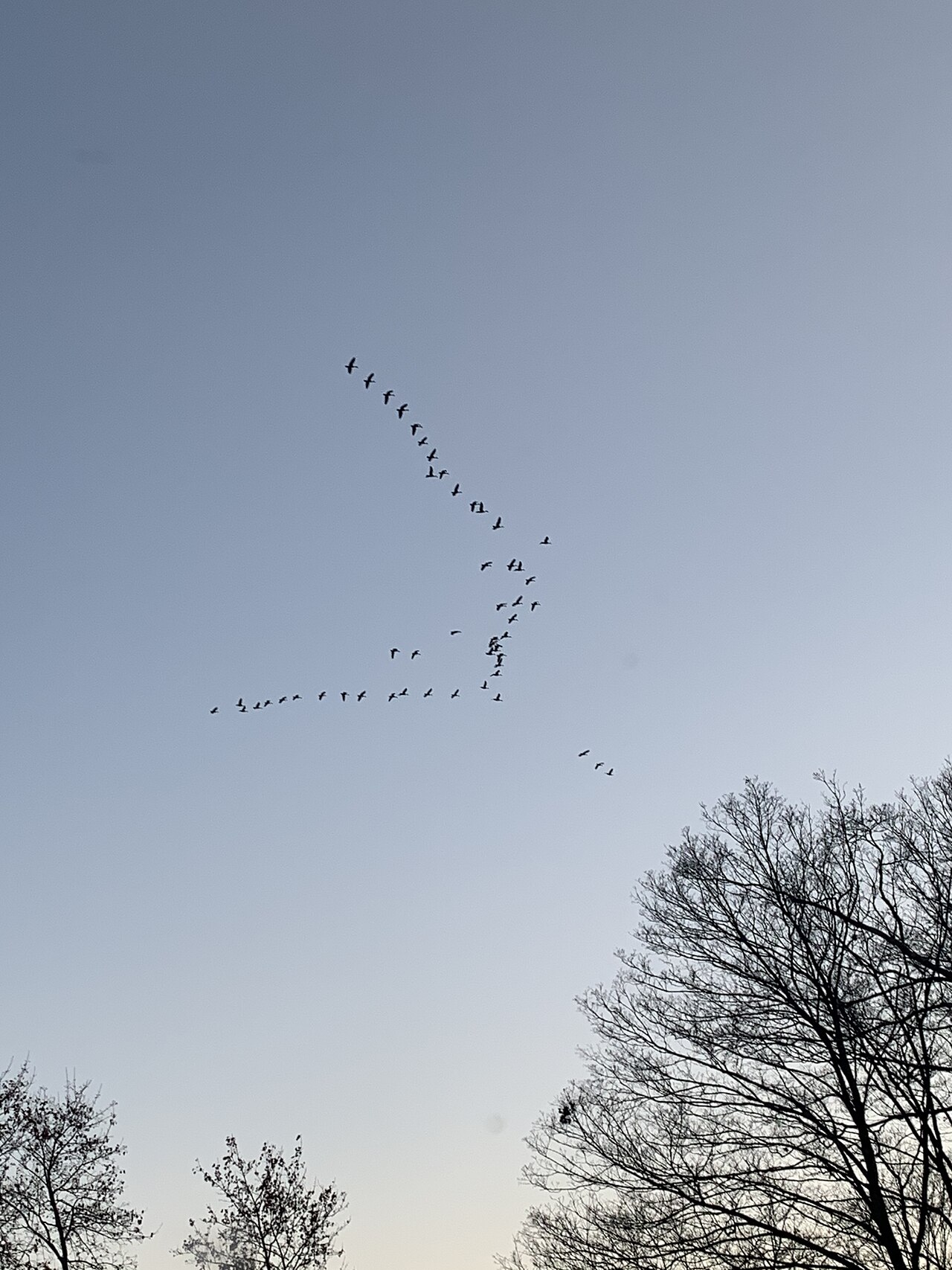
Half a million starlings carve a living sculpture across the dusk, folding, splitting, snapping back together a hundred times a minute. And not one of them is in charge.
There is no choreographer. No bird sees the whole flock. Each one is just watching its neighbours and trying not to crash.
That is the central magic of swarms, and it has a name we will earn over the next few lessons: emergence. Simple local rules, repeated by every agent, produce complex global behaviour, with no boss anywhere. The flock is smarter than any starling in it, and no starling knows.
The ant colony has no manager
Watch an ant colony for an afternoon. No ant holds a map. No ant issues orders. The queen lays eggs; she does not direct traffic. Yet the colony finds the shortest path to food, reroutes around obstacles, and rebalances its workforce between foraging and nest repair: feats of logistics that would humble a warehouse.
The trick is that each ant runs a tiny rulebook:
- If you find food, grab it and head home.
- If you smell pheromone, follow it.
- If you are carrying food, dribble pheromone as you go.
Nothing in those rules mentions “shortest path.” Yet the shortest route gets walked more often per minute, so its pheromone is refreshed faster than it evaporates, so more ants choose it, so it gets refreshed even faster. The colony computes an answer no individual ant could state. That is emergence: the global behaviour lives in the interactions, not in any one agent’s head.
Ant logic now parks real airliners
The pheromone trick is not stuck in the anthill. In 1992 Marco Dorigo turned it into an algorithm in his doctoral thesis, ant colony optimization, where simulated ants lay digital pheromone on the good paths through a graph and let the weak trails fade. It finds short routes through messy networks without anyone planning them.
Southwest Airlines took the same idea to the airport. A researcher named Douglas Lawson built a program where each arriving pilot behaves like an ant hunting for the gate it can reach and leave fastest, learning from past runs. As he put it, the pilot learns what is best for him, and it turns out that that is the best solution for the airline. The “colony” of pilots settles on gate assignments that keep planes moving, and the system can even warn of a back-up before it forms. Bug logic, full-size jets.
Three rules build a flock
In robotics the canonical version of this is flocking, and it reduces to a balance of three forces, each computed purely from what a robot can sense nearby:
- Separation: steer away from neighbours that are too close. (Don’t crash.)
- Alignment: steer toward the average heading of your neighbours. (Move as one.)
- Cohesion: steer toward the average position of your neighbours. (Stay together.)
The whole art is the balance. Strip out separation and the agents that attract and align just pile into each other: a clump, not a flock. Strip out alignment and there is no shared heading; neighbours drift every which way and the group never commits to a direction. Turn cohesion up too high and the swarm collapses into a knot; turn separation up too high and it scatters to the corners. A stable, collision-free flock is not a setting you dial in. It is a tension you hold.
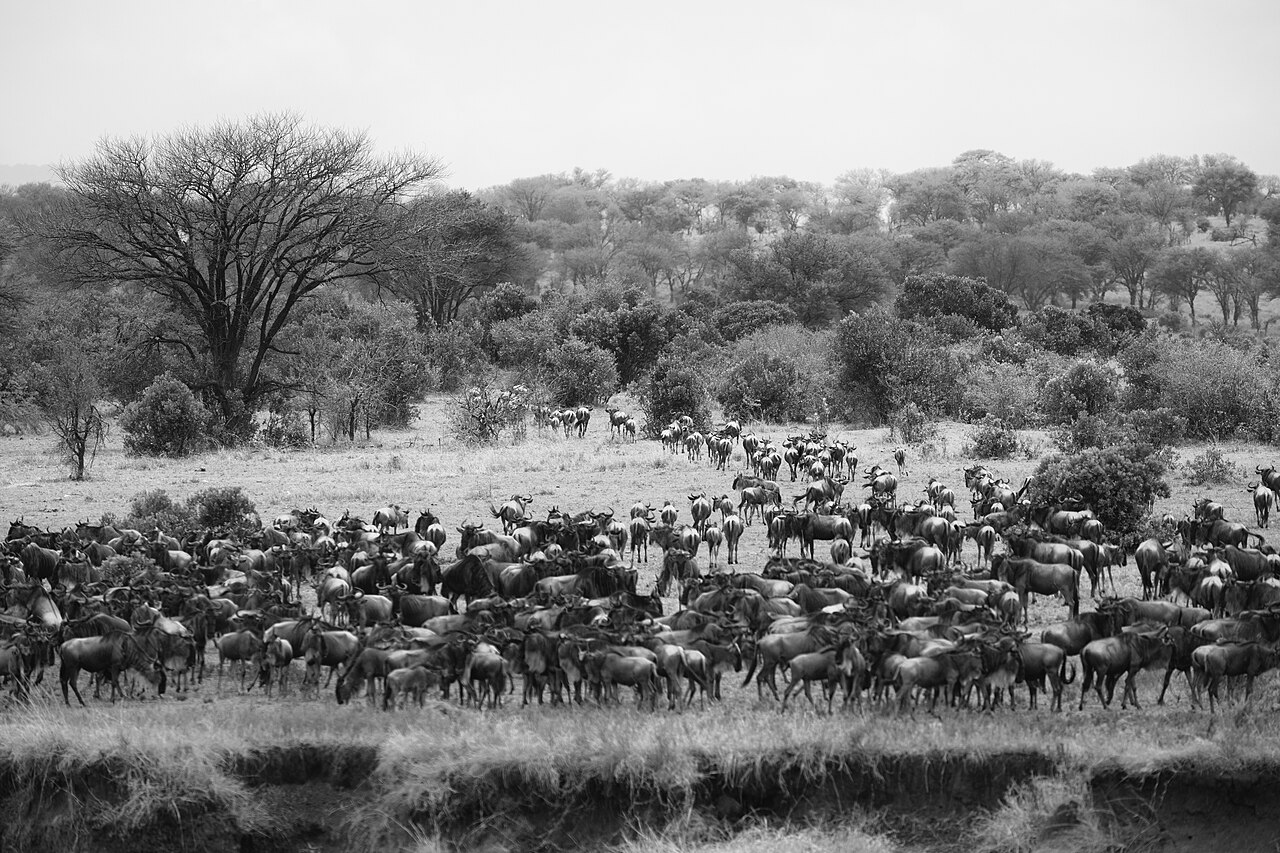
A bait ball is the same three rules under threat. When a predator lunges, the fish on the edge dart inward, their neighbours follow, and the school contorts into a shimmering sphere that confounds the attacker: an emergent defense with no commander calling the formation. Biologists file all of this under swarm intelligence; engineers borrow it wholesale.
Why engineers covet this
The killer property is scalability. Because every robot reacts only to its local neighbourhood, the rules don’t change when the swarm grows. Ten robots or ten thousand: the same three steering terms run on each one. Want a bigger swarm? Spawn more agents: no central controller to redesign, no bottleneck to widen, no single point whose failure dooms the mission. Lose a robot and the flock closes the gap and carries on.
This was a genuinely radical idea in robotics, and it had a champion.

The state update, made honest
The math: how each agent steps itself forward
Each robot carries a position and velocity , and integrates them forward with plain Euler steps:
The acceleration is where the swarm lives: it is the weighted sum of the three steering rules, each computed only from neighbours within sensing range. No term in references the global state, and that is the whole point.
Real actuators can’t deliver infinite force or speed, so both vectors are clamped:
In code, one agent’s update is just clamp, integrate, clamp again:
struct Agent {
    pos: Vec2,
    vel: Vec2,
    max_speed: f32,
    max_accel: f32,
}

impl Agent {
    fn update(&mut self, acceleration: Vec2, dt: f32) {
        let accel = acceleration.normalize()
            * acceleration.length().min(self.max_accel);
        self.vel += accel * dt;
        if self.vel.length() > self.max_speed {
            self.vel = self.vel.normalize() * self.max_speed;
        }
        self.pos += self.vel * dt;
    }
}
Run fifty of these in a unit square with random starts, give each a torus world so they wrap at the edges, and the flock appears on screen within seconds. You wrote a rule for one agent; emergence wrote the rest.
Key takeaways
- Emergence: complex global behaviour falls out of simple local rules, repeated by every agent. No agent holds the plan.
- No central controller: intelligence is distributed across the interactions, so there is no single point of failure and no bottleneck.
- Local sensing only: each robot reacts to nearby neighbours, never the whole swarm, which is exactly why the design scales without redesign.
The starling does not know it is a sculpture. The ant does not know it solved a shortest-path problem. The fish does not know it built a fortress out of itself.
That is the quiet wonder of the swarm: the intelligence is real, the boss is imaginary, and the whole is forever wiser than the sum of its very simple parts.