Distance-Based Formations
How a swarm holds its shape with no leader and no map
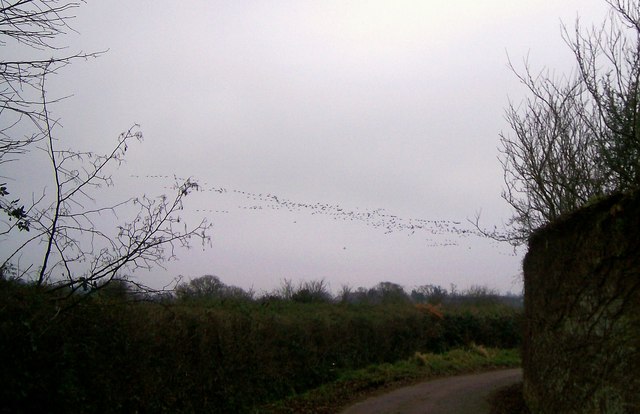
A thousand fish wheel as one and never collide. There is no captain, no shared map, no fish shouting coordinates. Each one is doing something almost embarrassingly simple.
It is keeping a fixed distance from its neighbours, and that, repeated everywhere at once, is the shape.
That is the whole trick of distance-based formation control. Forget global coordinates. Forget a leader broadcasting “everyone to position 47.” A robot in a distance-based formation knows exactly one kind of fact: I should be this far from that one, and that far from this one. Get every pairwise distance right and the shape falls out for free.
The rigid-rod picture
Imagine your robots bolted together with rigid rods of fixed length. Pull on the cluster and it slides across the floor; spin it and it rotates as a block. What it cannot do is change shape: the rods forbid it. That stiffness is the entire goal, and the beautiful part is that the rods are imaginary. Each robot enforces its own rod by watching one number: the distance to a neighbour, and how far that number has drifted from its target.
- Define a target distance for each connected pair .
- Each robot nudges itself to drive its distance errors toward zero.
- Do this everywhere, continuously, and the formation translates and rotates as one rigid body.
No robot ever needs to know where it is in the world. It only needs to know where it is relative to the robots it can see. That is what makes the idea scale: add a hundred more robots and no single one has to think any harder.
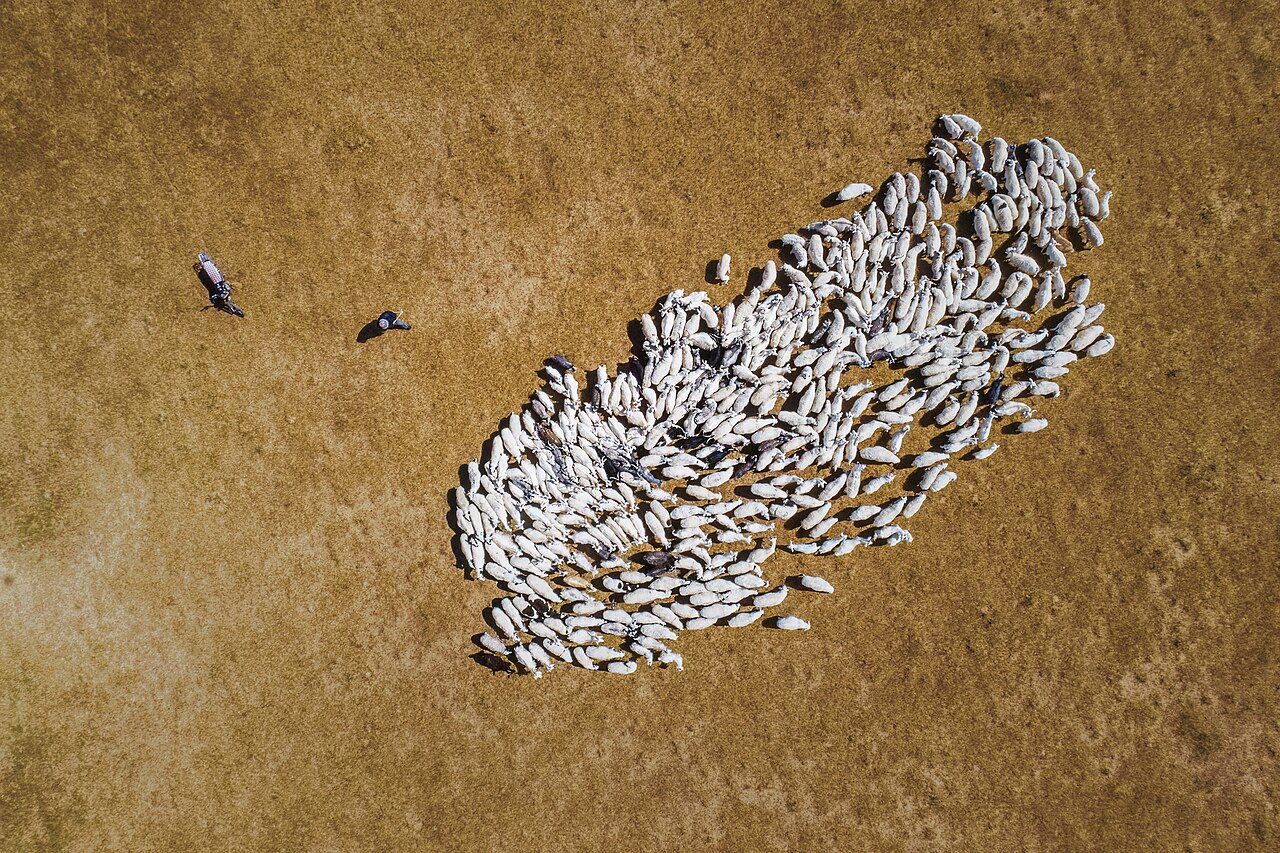
When the shape goes floppy
Here is where it gets subtle. Constraining distances is not the same as constraining shape, and the gap between them is where formations quietly fail.
A triangle of three robots, each holding a target distance to the other two, is rigid. Three constraints, three robots, locked solid: it can only slide and spin. Now take four robots in a square and constrain just the four edges. Looks pinned down. It isn’t. With nothing constraining the diagonal, the square can shear, collapsing smoothly into a parallelogram while every single edge length stays perfectly correct. The robots are all “satisfied” and the formation is melting in front of you.
Add one diagonal constraint and the shear is dead. That single extra rod is the difference between a shape and a sad rhombus.
Remove an edge from a rigid formation and it goes floppy again: the robots slide into a different shape while still honouring every remaining distance. So the real engineering question is never “are the distances right?” It’s “are there enough of the right distances to leave only one shape standing?”
The two jobs at once
The genuinely hard part isn’t holding a static shape. It’s holding the shape while the whole group moves toward a target. Every robot is simultaneously a shape-keeper (don’t let the formation deform) and a traveller (get us all to the goal). Those two pulls have to be balanced every instant: too much travel and the formation smears; too much shape-keeping and the group never leaves. Solve that tension and you have robots that march in tight formation across a room without anyone in charge.
The math: formation energy and the gradient that holds the shape
Treat the whole formation as a single spring network and write down its potential energy. For an edge set with target distances :
Every term is the squared error of one “rod.” The energy is zero exactly when every distance hits its target, and grows as the shape distorts. The controller’s job is to roll downhill on this surface, so each robot follows the negative gradient of the energy:
Read it physically: the fraction is a unit vector pointing from neighbour toward robot ; the scalar in front is the signed distance error. If is too far, the error is positive and the robot is pulled in; too close, and it’s pushed out. Each rod behaves like a spring with rest length , and the gain sets how stiff the springs are.
A formation is rigid when the distance constraints determine the positions uniquely, up to a rigid motion (translation and rotation). That “up to a rigid motion” is why the energy never tries to fix the formation’s global position or heading: sliding and spinning leave every distance untouched, so they cost zero energy and the controller leaves them free. The minimal recipe in the plane is the count from above; below it, the energy surface has a flat valley the shape can slide along without ever climbing, and that valley is the shear you watched the square fall into.
Key takeaways
- Shape from distances. Maintain target distances between neighbours and the formation holds, with no leader and no global coordinates.
- Constraints aren’t shape. A square held only by its four edges can shear into a parallelogram; you need the right number of the right constraints.
- Rigidity has a count. In 2D a formation needs at least distance constraints, or it flexes and shears.
- Two jobs at once. Keeping the formation rigid while the whole group translates is the real control problem.
A school of fish has no leader and no map, yet it turns as one and never tears. It does it with the humblest rule in the swarm playbook: stay this far from the ones beside you.
Get enough of those little rules pointing the same way and a shape appears out of nowhere: rigid, mobile, and answerable to no one. That is formation control: not a plan handed down from above, but an agreement that holds itself together from the inside.